All Saints' Day and Halloween
Did the Catholic Church Put All Saints' Day After Halloween as a Counter Move?
Every October, as costumes, candy, and Halloween decorations appear, a common question surfaces: Did the Catholic Church create All Saints' Day as a response to Halloween?
The short answer is both yes and no.
The relationship between Halloween and All Saints' Day is real, but not in the way many people assume. The popular image is that Halloween existed first as a pagan celebration and that the Church later invented All Saints' Day to compete with it. The historical story is more complex and far more interesting.
To understand the connection, we need to begin with the feast itself.
Long before Halloween became associated with trick-or-treating, haunted houses, and jack-o'-lanterns, Christians were honoring martyrs and saints. In the early centuries of the Church, local communities celebrated those who had given their lives for the faith. As the number of recognized saints grew, the Church eventually established a feast to honor all of them together.
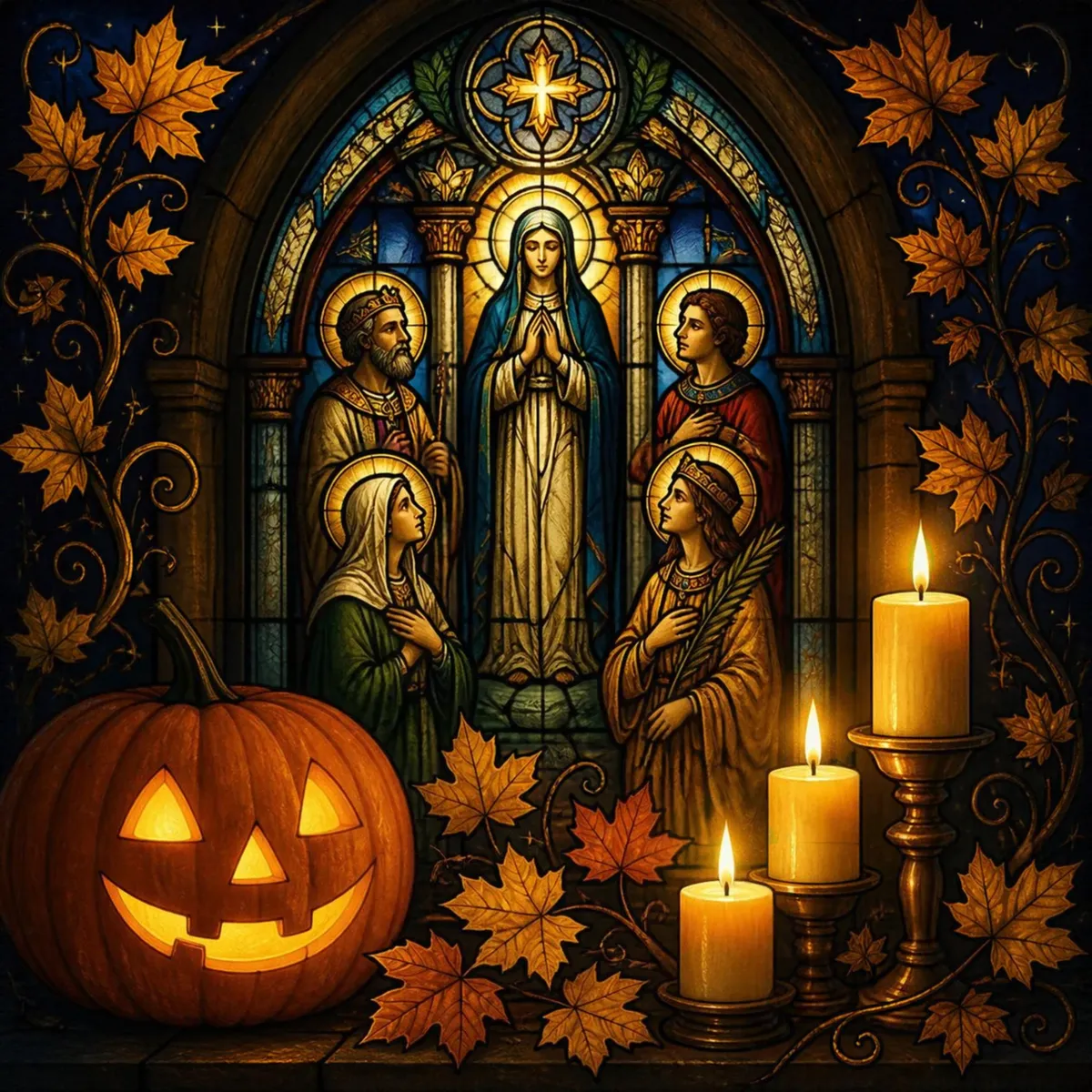
Over time, the celebration became fixed on November 1. The evening before a major feast day was known as a vigil, or "hallows eve," meaning the evening before the feast of all holy people. The term eventually evolved into the word we use today: Halloween.
That means Halloween actually derives its name from All Hallows' Eve, the vigil before All Saints' Day. In that sense, Halloween's connection to the Christian calendar is undeniable.
But what about the claim that the Church intentionally placed All Saints' Day on November 1 to replace a pagan festival?
Historically, there is evidence that the Church often sought to Christianize cultural practices rather than simply abolish them. Missionaries understood that people did not stop being human when they became Christian. Communities had customs, celebrations, and seasonal observances that were deeply woven into their lives. Rather than destroying every existing tradition, the Church frequently redirected them toward Christ.
This was not unique to All Saints' Day. Throughout history, Christian feasts were often celebrated within cultures that already had seasonal festivals. The goal was not merely to erase older customs but to give them new meaning through the Gospel.
Yet reducing All Saints' Day to a "counter move" misses the deeper purpose of the feast. The Church was not primarily trying to create an alternative celebration. It was proclaiming a central Christian belief: that those who die in Christ remain united to the living.
This brings us to one of the most beautiful teachings of the Catholic faith, the Communion of Saints.
The Church teaches that believers remain connected even beyond death. The saints in heaven are not distant historical figures. They are living members of the Body of Christ who continue to pray for the Church. We on earth continue our journey toward God, supported by their example and intercession. Those who have died and are being purified are also embraced within this communion and remembered in prayer.
Seen through this lens, the placement of All Saints' Day and All Souls' Day at the beginning of November takes on a richer meaning. The Church invites believers to look beyond fear, darkness, and death and focus instead on the hope of eternal life.
While modern Halloween often focuses on ghosts, monsters, skeletons, and things that frighten us, All Saints' Day points toward something entirely different. It reminds us that death is not the end of the story. The saints are living proof of Christ's victory over sin and death.
Perhaps the better question is not whether the Church was trying to counter Halloween. Perhaps the question is what message the Church wanted people to hear as winter approached and the days grew darker.
The answer was one of hope.
As Christians remembered the saints, prayed for the faithful departed, and reflected on eternal life, they proclaimed that death does not have the final word. Christ does.
So did the Catholic Church place All Saints' Day after Halloween as a counter move? Not exactly. The relationship is more intertwined than that. Halloween itself grew out of the Christian vigil before All Saints' Day, and the feast was never merely an alternative celebration. It was, and remains, a declaration that the saints are alive in Christ and that all believers are called to join them in the joy of heaven.
Love our faith reminders? Follow us on your favorite platform for more.
© 2026 Fix the Foundation Coaching. All rights reserved.
 |  |  |